Let me tell you about the light we are never meant to catch.
Let me tell you that the problem with light, is really a story about what gets seen and what does the seeing.
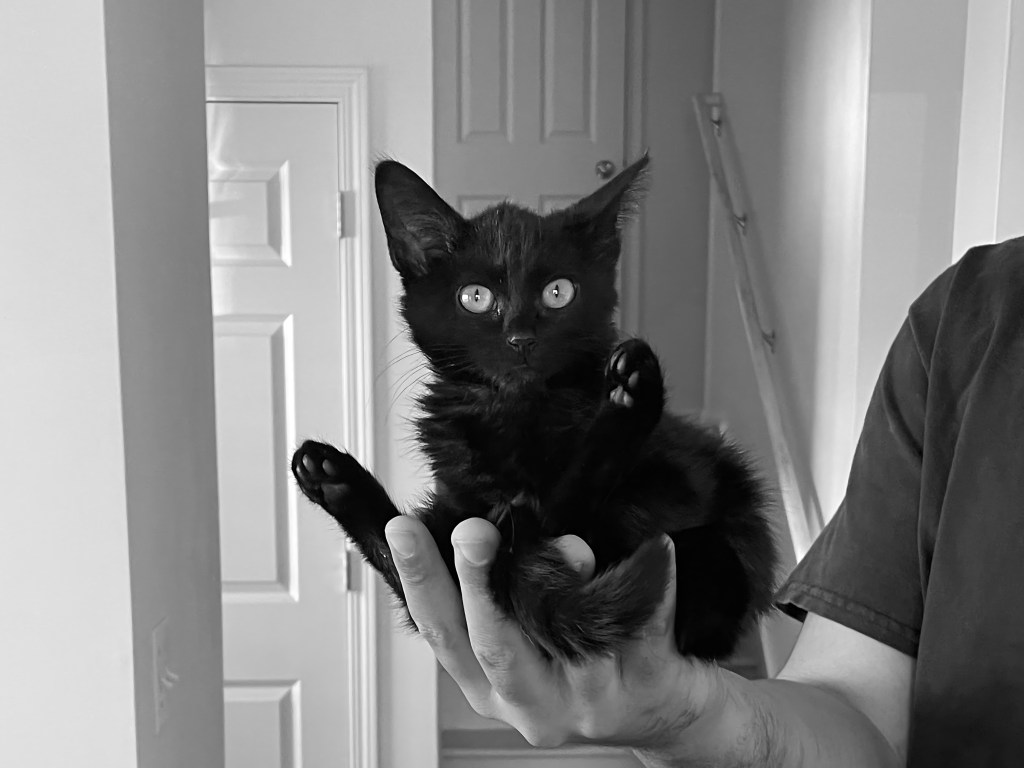
I did not want a cat. This is what I told myself, and what I told others, right up until the moment I found myself scrolling through adoption listings. For weeks, I made lists of cat-safe houseplants and compared the absorbency of different litters. The encouragement from those around me was gentle. Persistent. The kind that works not through force but through the slow erosion of whatever defenses you thought you had against wanting something you were not prepared to want.
I made demands because demands felt like control. A kitten, because I wanted to witness the becoming. Not one of the “bad ones”, by which I meant not one that would scratch, or hide, or fail to love me back at a time when I was desperate for something in the world to love me back out loud.
She had to be black, and she had to be named Wednesday. These were my only terms. In hindsight, perhaps because black cats and I both know something about being perpetually misunderstood.
When people hear of, or meet Wednesday, they always offer something similar. That “she must be a black cat” or “her name fits perfectly”. Images of Halloween, The Addams Family, and the costumes we’ve dressed darkness in for centuries, flash before all of our eyes. I smile and I nod, because the obvious connection is easier than the real one, because sometimes the truth requires more commitment than what people are ready to witness.
It might hurt your heart to know that black cats are the least likely to be adopted from shelters.
Making up only ten percent of all cats that find homes, they are also the most likely to be euthanized, at a rate of seventy five percent. The reasons people offer as their adoption choices reveal the landscape of our conditioning, giving reasons that are sometimes complicated and sometimes not. Some say black cats lack personality, that their obsidian black fur veils their features. Others fear the folklore; witchcraft, bad luck, the way darkness has always been blamed for what we cannot control or understand. Then, there are those who say black cats don’t photograph well, which I think might be the most honest answer of all. In a time where everything must be documented to prove that it happened, we have convinced ourselves to embrace only what looks good under the lights that we cast.
I’m writing this to you a few days before Wednesday’s first birthday, on the day my good friend Andrea Gibson died (who’s vision of me was always in the good light and always relentless), and a few days after a veterinarian traced my kitten’s body and told me some of her bones never grew correctly, most likely from lack of nutrition before she was found. “Often,” he says, his voice careful, as if his hands are handling something that might break, “this usually means they were kicked from the litter very early, most don’t live.”
Wednesday is not the first to have a record of rejection in her bones.
She is not the first to carry a history of unloved on her body.
I’ve never told anyone why I gave her Wednesday Addams name. Wednesday was always deliberate, always intentional. Wednesday Addams is a mirror that is held up to ourselves, revealing the parts of ourselves that scare us the most; the usefulness of darkness in sometimes the most uncomfortable ways.
The character of Wednesday Addams taught generations of us, perhaps unknowingly, that darkness is not the absence of love, but its deepest and most honest expression. In the Addams family home, death is honored, strangeness is celebrated, and the gothic themes that shape the plot are understood as another language for devotion. They found family not in spite of their peculiarities but because of them. The story of Wednesday Addams then, is less about gothic details and dark humor, and is instead about someone who figured out early that being liked and being known are very different things.
For most of my life, and similar to Wednesday Addams, and black cats, and perhaps you too, I have existed in the space between too much and not enough, which is really just another way of describing the experience of being a person who understands survival and self respect are never detached from one another. That this space often takes shape as being unwilling to perform the kind of gratitude that makes other people comfortable. In response, the boundaries of our worth are moved with precision, keeping characters like Wednesday Addams, black cats, and people, like me, perpetually reaching for a light that was never meant for us to catch. We are, instead, held in a light that veils the best versions of ourselves, a light that distorts our best and most honest features. A light that casts us as relentless when we should have been seen as persistent. Casts us as demanding when we should have been seen as thorough. A light that tells us we are too political, too angry, too disruptive, a killjoy, when it should have revealed our most honest image; someone who understands that joy, real joy, requires truth without compromise.
For most of my life, I have been desperate to be seen in the good light.
Both black cats and Wednesday Addams reveal a problem that most of us cannot name: that being consistently misunderstood by those who cannot see us in the right light and who cannot see us clearly, can be world ending. Most importantly, they share the same revolutionary understanding that persists the notion that what some calls darkness, whether it’s the color of fur or the complexity of personality is not something to overcome but something desperate to be embraced.
The problem then, is not actually about cats or television characters. Instead, about the mechanisms that we use to decide what deserves to be seen and what does not. Black cats are euthanized at rates that should make us uncomfortable, not because they are sick or aggressive but because they fail to photograph well, because they carry associations and old folklore that we have decided are bad fortune or compromise our own image, because they remind us of things we have been told to fear.
The image of Wednesday Addams lives under the same brutal and devastating logic. Despite the comedic frame, she was written as a child who could not be fixed, could not be made acceptable to the people around her, could not be convinced to smile when she felt no joy. The joke then, as we were told, were in her refusals to conform. That very joke reveals something more unsettling; that our collective investment in the idea that there is a correct way to be and to feel, and that a deviation from this is either comedy or pathology. What both black cats and Wednesday Addams understand, what they could teach us, is that the problem lies not in the darkness but in the light we that we choose to cast. We have been convinced that only certain optics reveal truth, when what they actually reveal is our own limited capacity for seeing. The revolutionary act, then, is not learning to be seen differently but refusing to accept the premise that there is only one way to be seen at all.
Wednesday Addams is a revolution I could feel before I could name.
Black cats are a revolution that are desperate to go home.
Today is my Wednesday’s first birthday.
She is a celebration of the freaks, the misunderstood, the unloved.
She is a reminder that the lights we are cast in are never our best truth.
most importantly,
She is the light we are never meant to catch.
bitterly yours,
chase owens
 The Bitter Northerner
Leave a comment